
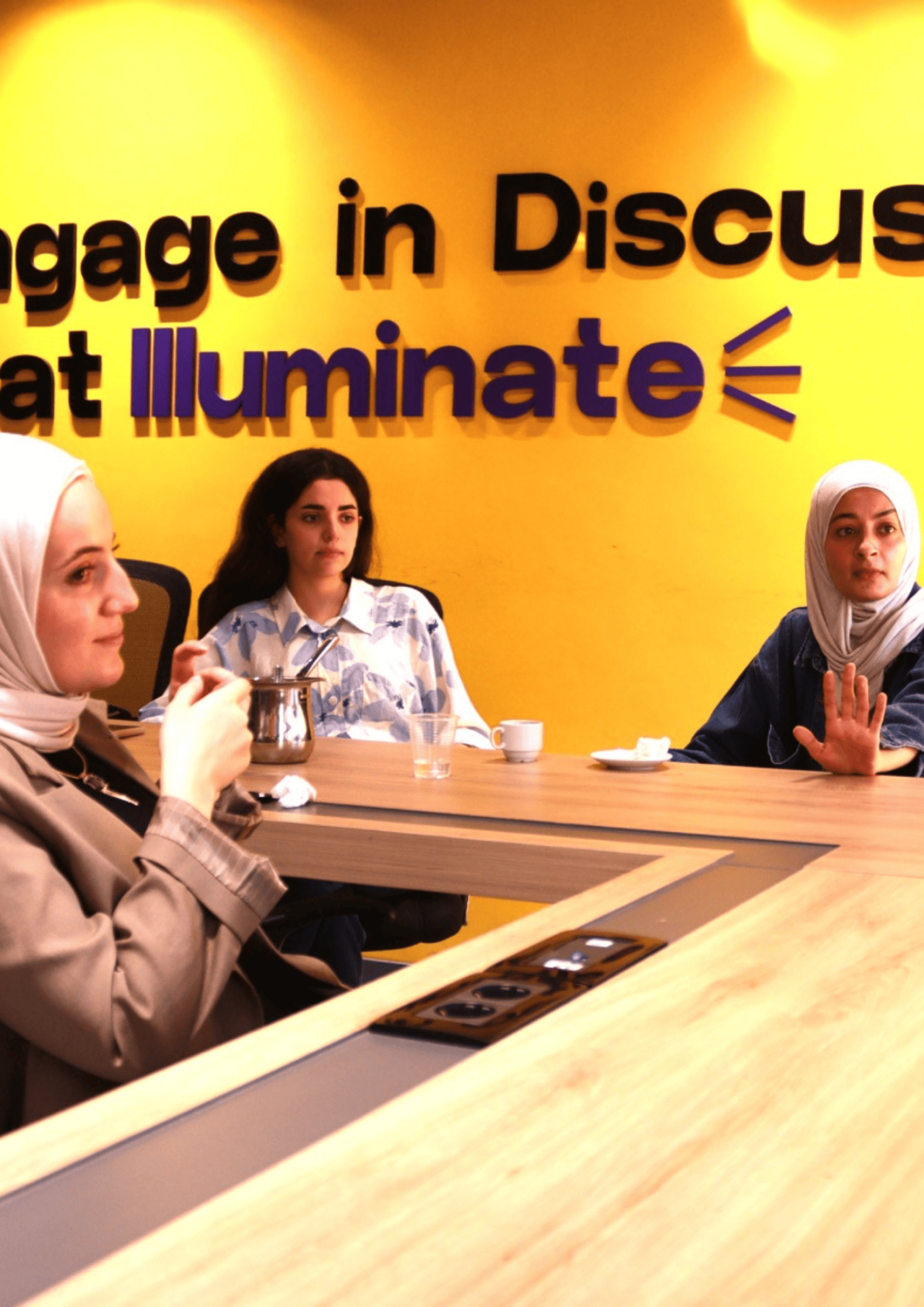
Making themselves heard; how a digital start-up led by two women entrepreneurs is paving the way for social business in Syria
“We would like our company to cater to every individual that suffers from some or the other kind of disability in this world. This, is our goal.”⸺ Naya, Co-Founder, SIGN
When the COSV team in Syria began designing the structure of a Hackathon and Bootcamp for a project on advancing digital entrepreneurship for the youth in Syria (DigiEYE) in 2024, the challenges appeared gigantic−at first. Mostly since this particular project was focused on the identification, training, coaching and seed funding of digital start-ups for social impact. In collaboration with the United Nation’s Development program and funded by the Government of Japan, the project’s unique selling point was the curation of ‘tech-for-good’ against the backdrop of the most severe disruption to Syria’s overall economy and infrastructure from its decades’ long conflict. Such programs of locating, coaching and funding start-ups were not new to the humanitarian/developmental support context in Syria. However, specific focus on start-ups with an orientation for social impact over and above sole profit making was certainly not commonplace in post-conflict Syria.
This is how we met the start-up SIGN. With unflinching faith in the product they had envisioned, an app called Sign-up under the stewardship of the parent company SIGN, they applied for the open call for selection to our project. The Sign-up application had been devised to conduct live translations for the deaf community in and outside of Syria. Their business model was in full alignment with our vision of ‘tech-for-good’ with the end objective of servicing a community in dire need while sustaining itself with a differential pricing mechanism. Users abroad, from countries such as the UAE, Saudi Arabia, Qatar and such, would be charged a subscription fee to help subsidize or obliterate the payments from the underprivileged clients in Syria.
Step after step, the co-founders, Naya and Farah proved their determination to hold space in an ecosystem that still lingers on the fault lines of conflict, disruptions and uncertainties. Acing the demonstration days and pitching events, their company become one of the seven start-ups that got selected to receive seed funding as well as incubation support at an advance acceleration hub in Damascus. With the seed money awarded, their vision could manifest into a fully functional service which is currently being used by clients from both Syria and abroad.
When asked about their motivation to delve into the unchartered arena of social business in Syria, their response was steadfast and sure; it was time to close the gap. What is this gap? That, there is a surge of deaf people in Syria with only 18 official translators to respond to their needs. “How could we let this gap remain.” Farah, the co-founder had responded to our question.
There are also other gaps and barriers that inhibit access to proper services for the deaf community in Syria. First and foremost, is the lack of proper data and thus, proper estimation of the total number of deaf people in the country. A back-of-the-hand calculation based on the Humanitarian Needs Assessment (2020-21) highlighted 7% out of the total population as affected by severe hearing difficulty, amounting to approximately 1.79 million people. The co-founders of the company further highlighted the abject disillusionment that runs within the circle of those that find themselves with a disability in Syria. Especially for the deaf community, comprehending legal documents remain a major challenge, and their inability to do so lead to instances of cheating and fraud. With the Sign-up app, any document can be easily uploaded and transcribed in sign-language by the translators in real time.
“The heartbreak begins from home,” Farah mentioned once when discussions were ongoing regarding the best suited design for the application. The seed fund they received from the project was a major boost to their business plan with direct support given towards the design and the building of the application. For the deaf people, the struggles begin with disrupted and frustrating conversational gaps within their own families. This powerful aspect is often left behind when building services for those that carry this disability. This is why the co-founders had absolute clarity on the design interface-simple and easy to navigate for everyone concerned. They now provide live interpretation sessions to parents and their deaf children in their homes via video calling.
Today, Naya and Farah continue to grow their business. The parent company SIGN now includes services for people with Usher syndrome along with general and customized sign-language trainings for a varied clientele. Their app Sign-up has provided 1200 hours of translation services to the deaf community in Syria so far as they continue taking strides abroad with their on-boarding as ‘international brand ambassadors’ with US based Usher Syndrome Coalition- an international coalition to raise awareness and accelerate research for the most common genetic cause of combined deafness and blindness.
When asked about their vision for their company’s future they say, “biggest global company to service the disabled community across the world,” with a big smile on their faces and fingers naturally shaped into a sign to convey the unmissable resolve in their words.


