
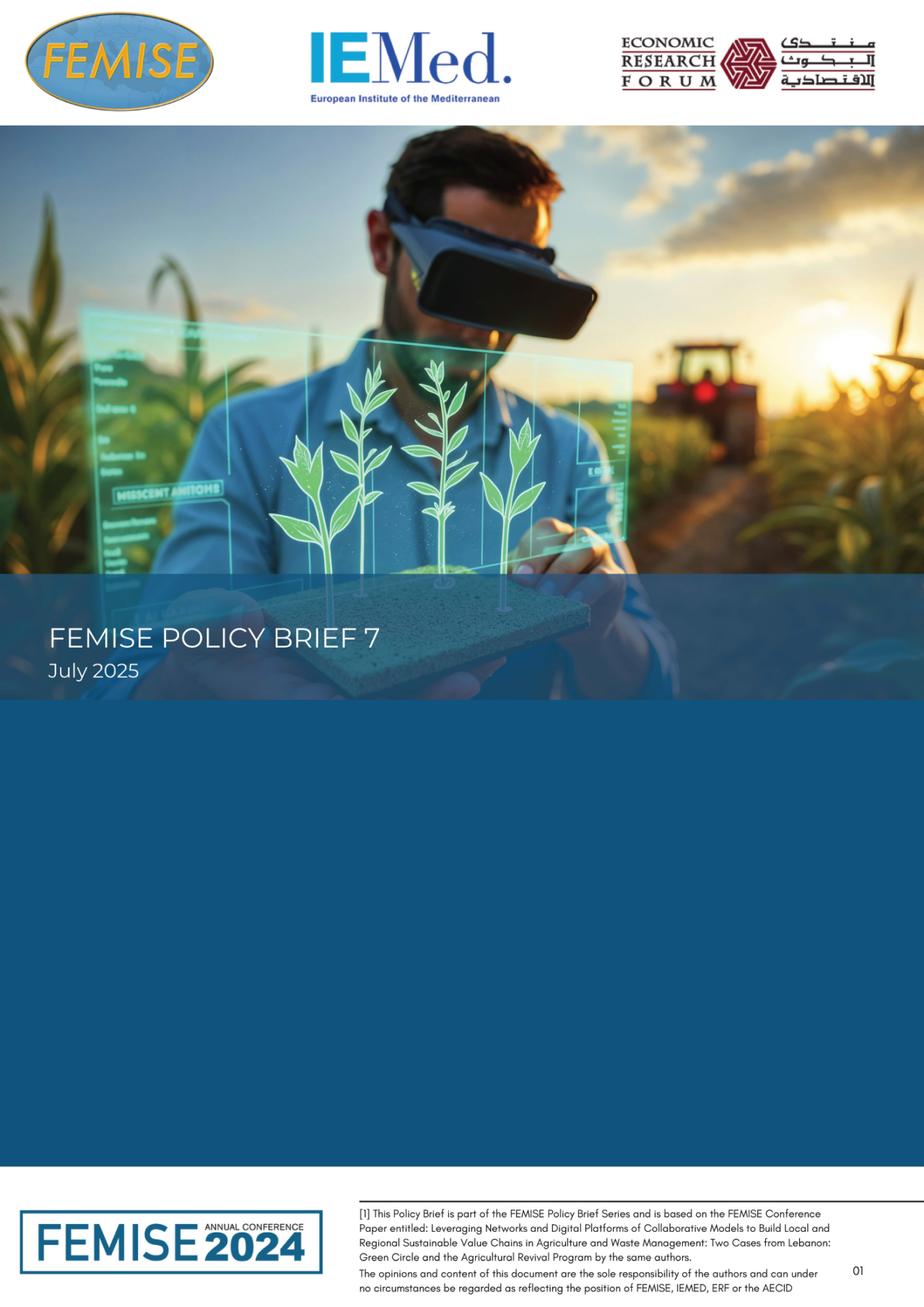
From Waste to Wealth: Digital Platforms and Networks Powering Lebanon’s Sustainable Value Chains
FEMISE Policy Brief 7 – July 2025
By: Dr. Mohammad Makki (COSV, USEK Business School) & Annalisa Contini (COSV)
Why This Study Matters
Lebanon, like much of the South Mediterranean region, faces pressing environmental and socio-economic challenges: fragile infrastructure, waste mismanagement, and an agricultural sector heavily dependent on imports. Yet, at the crossroads of these challenges lies an opportunity for transformation.
This policy brief demonstrates how digital platforms, networks, and collaborative models can turn waste into resources and smallholder farming into a driver of food security. By focusing on two pioneering initiatives — Green Circle and the Agricultural Revival Program (ARP) — the study showcases pathways to inclusive, sustainable, and resilient value chains in waste management and agriculture.
The work is rooted in the EU-funded SEE Change project, led by COSV with partners Oxfam and Beyond Group, designed to scale social entrepreneurship in Lebanon. It reflects FEMISE’s commitment to advancing knowledge-sharing and cooperation across the Euro-Mediterranean.
Core Insights
- Green Circle: Building a Zero-Waste Village
- Community-driven waste collection, sorting, and recycling.
- Transformation of organic waste into fertilizers, creating a circular economy.
- Supported by digital platforms for awareness, logistics, and scaling.
- Outcome: Bchatfin village evolving into a model zero-waste community, generating jobs, eco-products, and sustainable consumer behavior.
- Agricultural Revival Program (ARP): Strengthening Local Food Systems
- Provides small and medium farmers with high-quality seeds, training, and guaranteed markets.
- Establishes a model farm as a hub for knowledge-sharing.
- Reduces dependency on imports and enhances national food security.
- Outcome: Dozens of farmers empowered, 118 tons of crops harvested in the first year, and growing agro-processing initiatives for long-term resilience.
The Transformative Role of Networks and Digital Platforms
Both Green Circle and ARP demonstrate that collaboration is more than partnership — it is co-creation. By harnessing:
- Digital tools (Zoom, Teams, Catalyst 2030 exchanges) for knowledge-sharing.
- Cross-border networking to replicate and adapt models.
- Hybrid funding strategies combining grants, sales, and cooperative approaches.
These models prove that even in fragile contexts, innovation can scale, communities can mobilize, and economies can regenerate.
Policy Recommendations
To replicate and amplify impact, the study calls for:
- Governments to modernize regulatory frameworks, create incentives, and support pilot zero-waste and agro clusters.
- Enterprises to pool resources, integrate ESG standards, and embrace collaborative marketplaces (digital and physical).
- International donors and NGOs to strengthen value chain creation, foster knowledge exchange, and co-finance pilot initiatives.
- Cross-border collaboration to harmonize certifications, open regional markets, and share technological solutions.
A Motivational Outlook
This brief is not only about Lebanon — it is a message for the wider South Mediterranean:
- Waste is not just a burden, but a resource for innovation.
- Agriculture is not just survival, but a foundation for sovereignty and resilience.
- Networks are not just connections, but pathways to collective strength.
By harnessing the power of the Social and Solidarity Economy, Lebanon and its neighbors can move from fragmentation to collaboration, from vulnerability to resilience, and from waste to wealth.
The message is clear: a vibrant social and solidarity economy can transform Montenegro’s rural areas, empower its youth, reduce inequalities, and bring the country closer to the European Union.
